
Monaco 2025: nearly 39,000 residents and unwavering demand for real estate
Monaco, a unique city-state in the world
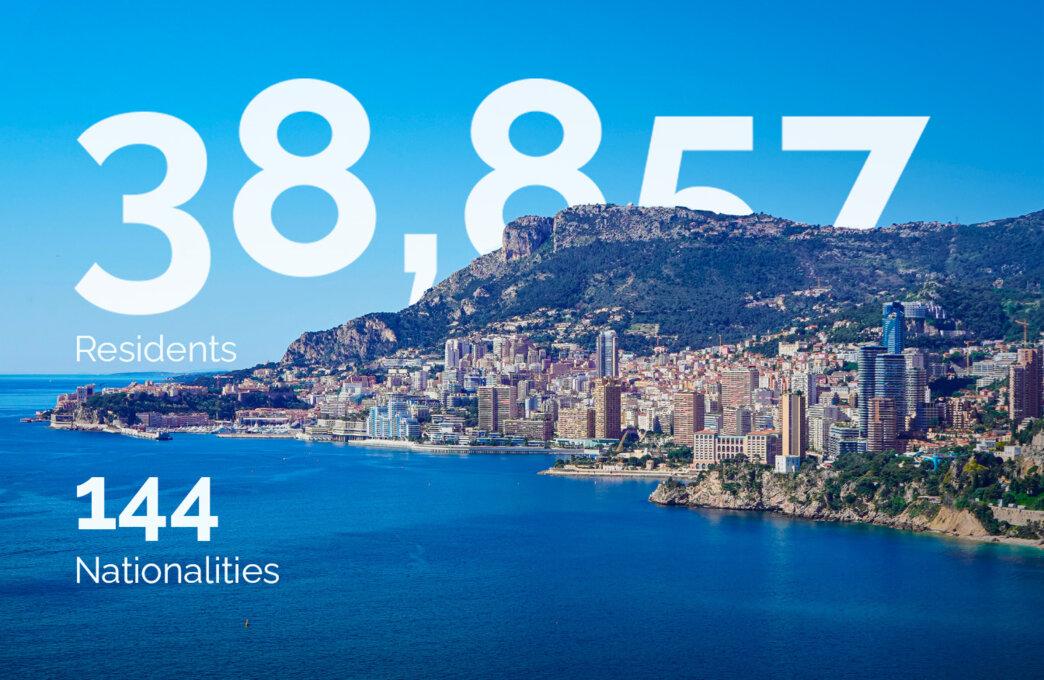
Covering 2,09 km² in the heart of the Mediterranean, Monaco is now home to 144 different nationalities. French, Italian and English are spoken fluently, European cultures rub shoulders naturally, and the Principality is one of the few territories in the world where a new foreign resident can integrate without friction. whatever its origin. It is precisely this cosmopolitan identity, rooted in a centuries-old tradition of openness, that forms one of the most enduring foundations of its residential attractiveness.
A Principality that continues to grow
As of 31 December 2025, Monaco had 38,857 residents, 434 more people than a year earlier (+1.1%). Over ten years, the trend is even more eloquent: the population has gained nearly 500 residents since 2016 (37,308 inhabitants), and more than 6,800 since 2000.
In the long term, the Principality has almost doubled its population since 1951. A slow but continuous growth trajectory, which distinguishes Monaco from many European cities and which, in a territory that is by definition not expandable, maintains structural real estate pressure.
What this means for real estate: upward residential demand in the long term, in a market where the land supply cannot mechanically keep up.
A mosaic of 144 nationalities: a portrait of the international clientele
The Monegasques remain the leading community with 9,333 residents (24.0%), ahead of the French (8,270, or 21.3%) and the Italians (7,559, or 19.5%). The British exceeded the symbolic threshold of 3,000 people (3,081 residents, 7.9%).
Further down the ranking, the Swiss (1,237), Russian (1,209) and Belgian (1,038) communities form a well-established Central and Northern European bloc. Americans (485) and Canadians (416) together represent nearly 900 English-speaking North American residents. The Ukrainians (361) and the Israelis (191) complete a resolutely international picture.
Major trends by nationality: a demographic map in motion
The table of developments between 2024 and 2025 draws particularly instructive dynamics for understanding real estate demand in Monaco.
The British rise: Brexit and the end of the non-dom regime
The most spectacular increase concerns the British community, with +163 residents in one year, bringing its total to 3,081. Since 2016, the increase has reached +285 people. Two factors combine to explain this growth.
First, Brexit has led many affluent British residents to rethink their European roots. Monaco, in the heart of continental Europe, less than two hours from London by plane, offers a premium living environment and an incomparable international network continuity.
Secondly, and even more decisively, the abolition of the non-dom regime in the United Kingdom, effective since April 6, 2025, marks a historic break. This status, which was two centuries old, allowed British residents whose tax residence was declared abroad not to be taxed on their foreign-source income and capital gains. Its abolition by the Labour government now subjects anyone who has been resident in the UK for more than four years to worldwide taxation on all their income and capital gains. For wealthy people with international wealth, the calculation is simple: Monaco, which levies no income tax, no capital gains tax and no wealth tax, becomes a structurally attractive alternative.
Among the other nationalities on the rise between 2024 and 2025:
-
Italians: +76 residents, consolidating their position as the 3rd community
-
Germans: +44 | Spanish: +32 | Canadians: +41 | Americans: +37
-
Swiss: +28 | Israeli: +26
Political signals
The Ukrainian community illustrates the impact of crises on migration flows to Monaco: it had only 99 people in 2016 and now has 361, with +43 new settlements between 2024 and 2025. The majority of Ukrainian residents are women (66.2%), with a particularly young average age of 34.6 years, which reflects the circumstances of their departure.
The Russian community, which has increased by +460 people since 2016, has a similar profile of strong feminization of recent arrivals.
The French Paradox
The French community is the only one to see a significant decline, with -100 residents over one year and more than -1,000 since 2016. Paradoxically, the French are also the first nationality among the new residents who have settled since 2023 (nearly 550 arrivals). The explanation lies in demographics: many long-term French residents leave Monaco over time — notably by death or departure — while newcomers do not fully compensate for these departures. In addition, there are Monegasque naturalisations, which mechanically remove residents from the French count.
Real estate reading: the diversification of nationalities is continuously broadening the profile of the potential buyer or tenant. The British, North American and Central European communities, which are growing rapidly, are demanding customer segments with high purchasing power, for whom Monaco represents a well-thought-out and sustainable choice of residence.
The country of origin: a strong signal from the market
Among the adult foreign residents living in Monaco since 2023:
-
30.7% come from France (first geographical source)
-
19.0% are from the United Kingdom
-
9.4% arrive from Italy
-
6.2% from Switzerland
-
2.7% from Germany
What these numbers reveal beyond nationality is the market in which new residents leave — and therefore the type of property they have left and the price references they bring with them. A buyer coming from London or Geneva arrives with service standards and price levels that make Monaco a destination that is certainly premium, but consistent with what he knows. The fact that nearly one in three new residents comes from a country outside the top 5 also confirms the growing diversification of incoming profiles, beyond the historical Franco-Italian basins.
One noteworthy point: among Russians who have recently settled, less than one in four comes directly from the Russian Federation. Many of them already resided in Western Europe before choosing Monaco, which testifies to the well-established intra-European mobility of wealthy residents.
More than a third of residents work in Monaco
Monaco is not only a land of heritage residence: it is a major employment area on the Côte d'Azur, with more than 65,000 employees in its companies and administrations, nearly nine out of ten of whom live outside the territory.
Among working-age residents (18-64 years old), 35.8% are in paid employment in Monaco in 2025, including 25.7% in the private sector and 10.1% in the public sector. The peak of activity is between the ages of 35 and 44, with an employment rate of 45.5%.
What this means for real estate: a significant proportion of residents are qualified workers — senior executives, managers, liberal professions — looking for properties that combine comfort, location and services in line with their standard of living.
22,577 housing units listed: a slightly growing stock
The 2025 census counts 22,577 dwellings, up 1.8% over one year. Monte-Carlo has the largest number of units with 5,365 housing units (23.8% of the housing stock), followed by La Rousse with 4,885 housing units (21.6%). These two districts alone account for nearly half of the Principality's residential stock.
Growth was particularly marked in certain sectors: Les Moneghetti (+6.0%), the Jardin Exotique (+5.3%) and La Condamine (+4.0%) recorded the largest increases, reflecting the recent deliveries of new real estate developments.
On the profile of the accommodation sought:
The report does not contain direct data on the size of properties sought or occupied by new residents. On the other hand, there are certain elements that allow us to move forward cautiously in this area. Among the new settlements since 2023, the British and Swiss arrive at an average age of 49, the Russians at 44 and the French at 40 — age groups that often correspond to established households, potentially with children. In addition, the census indicates that one in two adult residents is married. These elements suggest that new residents may be more interested in 3- or 4-room family properties, rather than studios or small areas
State-owned vs. private: where is the free market?
Understanding the structure of the Monegasque stock is an essential prerequisite for any foreign buyer or investor.
In 2025, 80.6% of housing will be in the private sector (approximately 18,200 units), compared with 19.4% of state-owned housing owned by the Monegasque State (4,380 units). It is exclusively on this private market that real estate transactions accessible to international buyers and tenants are carried out.
The disparities between neighbourhoods are significant:
-
Larvotto and Monte-Carlo: the lowest share of state-owned housing in the Principality — 1.1% and 2.9% respectively. These sectors concentrate the highest density of private assets available.
-
Fontvieille: 37.9% of state-owned housing, the highest proportion.
-
Jardin Exotique, La Condamine, Les Moneghetti: about 29-30% of housing is owned by the State.
A Structurally Constrained Real Estate Market
Behind Monaco's residential appeal lies a mathematical reality that the 2025 census data allows us to measure with precision. The Principality counts 18,197 private dwellings across a territory of 2.09 km² — recently extended through the Mareterra land reclamation project, yet fundamentally finite.
Over two years, 2,700 new foreign residents chose to settle in the Principality, while only 1,013 private dwellings were created over the same period, despite sustained construction activity. And while the natural turnover of residents — approximately 2,300 departures over the same period — does release part of the existing stock, it is not enough to balance the equation: every available property is quickly absorbed, by incoming residents and by those already living in Monaco seeking to relocate.
This is therefore not a cyclical overheating that defines the Monegasque market, but a structural and permanent tension between a supply constrained by geography and sustained international demand. It is precisely this reality that makes Monaco, over the long term, one of the most resilient real estate markets in the world.
Monaco, a destination to settle in, not just to invest
Beyond the figures, what the 2025 census confirms is the vitality of a unique model. Monaco is a state where French, English and Italian are spoken naturally in the streets, shops and offices. Where the 144 resident nationalities coexist in a safe, compact environment with a quality of life that is unparalleled in Europe. Where a New York business owner, an Italian family or a British entrepreneur can set up shop without having to relearn the codes of a foreign company.
Are you thinking of moving to the Principality? Our BARNES Monaco teams support you at every stage of your residency project: identification of the property, advice in the neighbourhood, contact with legal and tax partners, and follow-up of your installation. Contact us for a confidential initial consultation.
Article written by BARNES Monaco based on official data from IMSEE (Monegasque Institute of Statistics and Economic Studies), Population Census 2025, published in May 2026.